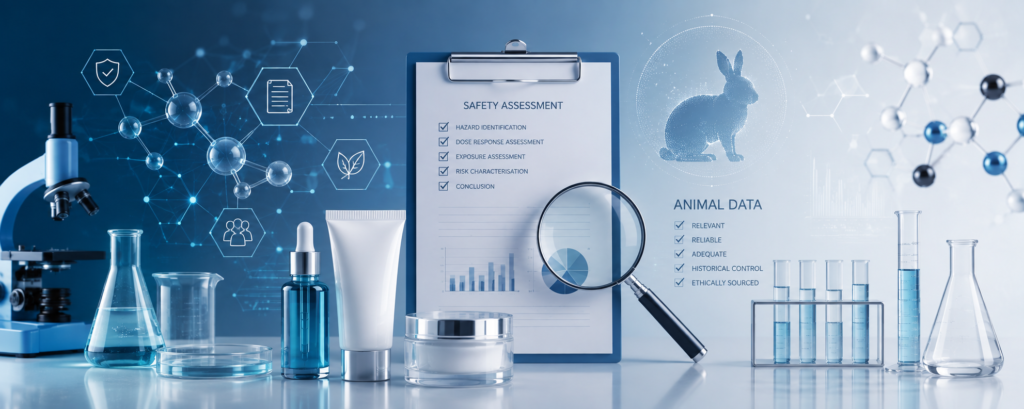
It’s a question I get asked fairly regularly, and it’s a fair one. If animal testing for cosmetics has been banned, why does the safety assessment for your product contain references to animal studies? Isn’t that contradictory — or worse, illegal?
The short answer is no. Let me explain why.
The Ban Is on New Testing, Not on Existing Data
The UK and EU cosmetics regulations prohibit the conduct of new animal tests on cosmetic ingredients or finished products, and they prohibit the marketing of products where new animal testing has been carried out to satisfy cosmetic safety requirements. That much is well known, and rightly celebrated.
What the regulations do not do is prohibit the use of animal test data that already exists. This distinction is absolutely crucial, and it’s one that often gets lost in the public conversation about cruelty-free cosmetics.
Where Does the Existing Data Come From?
Many of the ingredients used in cosmetics today — preservatives, emulsifiers, UV filters, surfactants, fragrances — have been in use for decades. During that time, and before the bans came into force, safety data was generated using animal studies. That data is now lodged in scientific databases, regulatory dossiers, and published literature. It doesn’t disappear simply because the regulatory landscape has changed.
As a cosmetic chemist carrying out a safety assessment under Annex I of the UK Cosmetic Products Regulation (or its EU equivalent), my job is to gather and evaluate all relevant safety data on every ingredient in your formulation. If the best available toxicological data for a particular ingredient happens to come from a study conducted on animals thirty years ago, I am professionally and legally obliged to include it. Ignoring it would make the safety assessment less rigorous, not more ethical.
The No-Animal-Test Logo Doesn’t Tell the Whole Story
Many brands display the Leaping Bunny logo or similar cruelty-free certification marks, and these are meaningful — they confirm that no new animal testing has been commissioned at any point in the supply chain. But a product can carry that certification and still have a CPSR that references animal-derived data. The two are entirely compatible. The certification addresses what has not been done recently; the CPSR records what is known about ingredient safety from all available sources.
What Are the Alternatives?
The cosmetics industry has invested heavily in developing alternative test methods — in vitro cell-based assays, computational (QSAR) modelling, reconstructed human tissue models, and read-across from structurally similar ingredients with known safety profiles. Where validated alternative data exists and is scientifically robust, I use it. Increasingly, for newer ingredients or reformulated actives, this is exactly what the safety evidence base looks like.
But for the vast majority of established cosmetic ingredients, the foundational toxicological database is built on older animal studies, and there is no scientifically equivalent alternative dataset to replace it. Until that changes — and progress is being made — those studies will continue to be cited in CPSRs.
The Bottom Line
Seeing animal study references in your CPSR does not mean animal testing was carried out on your product or its ingredients. It means your safety assessor has done their job thoroughly, drawing on the full body of available scientific evidence. That is precisely what the regulations require, and precisely what protects your consumers.
If anything, a CPSR that contained no historical animal data — for a formulation built entirely from long-established ingredients — would be the document that raised questions.

Colin, this is an excellent clarification and one that needs repeating — the confusion between “uses existing data” and “conducted new testing” is genuinely widespread, particularly among indie brands commissioning their first CPSR.
From the supplier side, this question actually shapes how we structure our documentation packages. When a safety assessor needs to build a toxicological profile for a raw material, the quality and completeness of what the supplier provides has a direct impact on how efficiently that CPSR can be completed. A batch COA that only lists purity and appearance gives the assessor very little to work with. A comprehensive package — assay by HPLC, heavy metals panel, microbial limits, residual solvents where applicable, and referenced NOAEL values with the source studies cited — dramatically reduces the time and cost of the assessment process.
This is a particular issue with ingredients sourced from China, which is where I work. Many Chinese suppliers provide COAs that are essentially marketing documents — a single page with a product name, a purity number, and a company stamp. No analytical method specified, no batch traceability, no reference to pharmacopoeia or ISO standards. For a safety assessor trying to establish a margin of safety calculation, that document is essentially useless. The assessor then has to source the toxicological data independently, which adds time and cost that the brand ends up paying for.
We put together a guide specifically on how to evaluate COA quality from a procurement perspective — covering what analytical methods should be specified, what red flags to look for, and how batch-level traceability should work: https://onerchem.com/knowledge/sourcing/how-to-read-cosmetic-ingredient-coa/
Your point about QSAR and read-across is well taken. For newer botanical actives like bakuchiol where the historical animal database is thin, computational approaches and in vitro data are increasingly the primary safety evidence. The challenge is that not all suppliers provide the purity and compositional data needed to run a meaningful read-across — which brings it back to the documentation question again.